
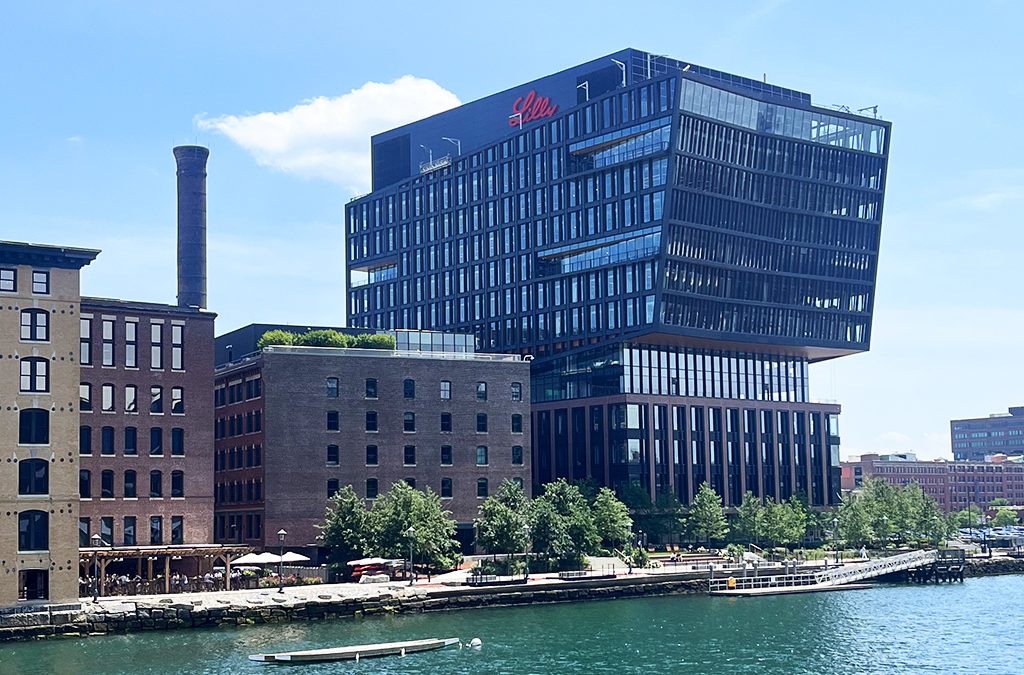
The world’s most valuable pharmaceutical company, Eli Lilly & Co., on Tuesday officially opened its new Lilly Seaport Innovation Center in Boston. The $700 million building will accommodate Lilly’s expanding workforce in Massachusetts and serve as the company’s hub for gene-based treatments.
The upper floors of the 12-story building at 15 Necco St. jut out toward Fort Point Channel like the prow of a ship. Nestled among brick buildings that once warehoused wool, the 346,000-square-foot structure contains laboratories where scientists will develop genetic medicines.
Nearly two-thirds of the building consists of lab space. Lilly scientists will work on RNA- and DNA-based medicines, as well as pursue novel treatments for diabetes, obesity, cardiovascular disease, neurodegenerative conditions, chronic pain, and other diseases.
“I’m super, super, super excited,” Daniel Skovronsky, Lilly’s chief scientific officer, said last week. “It’s a building a scientist can love. I’m a scientist, so I’m in love.”
The more than 200 Lilly scientists and researchers who had worked at 450 Kendall St. in Cambridge and made up the company’s modest workforce in Massachusetts have moved into the new research and development center, he said. Lilly plans to add about 300 more employees through hires, giving the Indianapolis-based company 500 employees in the state.
The center occupies a site that General Electric had once hoped would become part of its corporate headquarters before the legendary company went into a tailspin and scrapped the plan.
The building will also house a biotech incubator for 12 to 15 promising startups that employ another 200 workers. This will be the fourth of Lilly’s so-called Gateway Labs (there are two in South San Francisco and one in San Diego), which create opportunities for fledgling biotechs to collaborate with Lilly scientists.
Four biotechs have started moving into the building or plan to later this year: Tevard Biosciences, Amplitude Therapeutics, FireCyte Therapeutics, and Solu Therapeutics. They pay rent to Lilly for their laboratories, which feature impressive views of the Boston skyline.
Daniel Fischer, cofounder and chief executive of Tevard, said during a tour of the incubator Tuesday that working in the same building as Lilly scientists can foster collaboration through the oft-mentioned “bump factor” — the chance to bump into other scientists and discuss what they are working on. Nonetheless, he said, Tevard will operate independently of Lilly and maintain ownership of its intellectual property.
Tevard’s lead drug program encompasses potential treatments for genetic forms of epilepsy, including Dravet, a rare and catastrophic type that afflicts Fisher’s 15-year-old daughter. (Tevard is Dravet spelled backward because the company wants to reverse the condition.)
Lilly has long had a relatively small workforce among the 18 big biopharma companies with a presence in Massachusetts. Kendalle Burlin O’Connell, chief executive and president of the Massachusetts Biotechnology Council trade group, said that Lilly’s expansion in Fort Point “is a testament to what we already know: We are the best place in the world for research and development.”
It’s also a testament to the growth of Boston — particularly the Seaport District and neighboring areas — as an alternative to Kendall Square for housing drug companies. In the 10 years since Vertex Pharmaceuticals moved from Cambridge to a sprawling complex on the waterfront, the Seaport has attracted companies such as Alexion Pharmaceuticals (the rare disease unit of the British-Swedish drug maker AstraZeneca), CRISPR Therapeutics, Servier Pharmaceuticals, Foundation Medicine, and others.
The new building was designed by Elkus Manfredi Architects, of Boston, and co-developed by Alexandria Real Estate Equities and National Development.
It is opening at an auspicious time for Lilly, which has transformed itself from a stodgy underperformer into what some experts call the hottest pharmaceutical company in the world.
The 148-year-old firm has the largest market value of any drug maker, at roughly $800 billion. Its stock has risen about 66 percent over the past year, fueled by soaring sales of its blockbuster diabetes drug Mounjaro and weight loss injection Zepbound, said David Risinger, an analyst for Leerink Partners.
The company won approval last month of Kisunla, the second drug that scientists agree modestly slows the progression of Alzheimer’s disease in patients with early symptoms. And last Thursday, Lilly reported second-quarter earnings and revenue that surpassed expectations, increasing its full-year revenue projection by $3 billion.
Risinger said Lilly is wise to bet some of its winnings on gene-based treatments.
“It’s wonderful to see the company reinvesting outsized profits from obesity [drugs] into genetic medicine, and there’s no better place than Boston to leverage and attract talent from a number of the world’s best universities,” he said.
The Food and Drug Administration has approved a number of genetic medicines in recent years to mostly treat rare diseases. They include gene therapies that replace defective genes with healthy ones to fight conditions ranging from hemophilia to sickle cell disease. They also include medicines that use RNA interference, or RNAi, to “silence” disease-causing genes.
Lilly made its first major foray into genetic medicine in 2020 when it acquired New York-based Prevail Therapeutics for about $1.5 billion. Prevail’s lead gene therapy candidates included treatments for neurodegenerative diseases.
Two years later, Lilly paid $487 million for Boston-based Akouos, which was developing gene therapies for inherited forms of hearing loss. Today, genetic medicines account for more than a third of Lilly’s pipeline of experimental drugs, according to the company.
Although genetic medicine has focused so far on treatments for rare diseases, Skovronsky said Lilly hopes that its scientists can eventually use it for common diseases, including cardiovascular disease, Alzheimer’s disease, Parkinson’s disease, and age-related hearing loss.
“The real promise will be to address very common diseases that we haven’t had great treatments for,” he said.
This article was originally published by Jonathan Saltzman at The Boston Globe: https://www.bostonglobe.com/2024/08/13/business/eli-lilly-center-genetic-medicine-fort-point